
John Salverda Excerpts and Commentary. 31 August 2026, 18 Elul 5785.

Excerpts from Articles by John R. Salverda with a few comments by Yair Davidiy.
Danaans by John R. Salverda
The Identification of Israel with Saturn by John R. Salverda
Europa and Jeroboam of Israel by John R. Salverda
Sisyphus and Josephby by John R. Salverda
Salmoneus as Judah by John R. Salverda
Moses, Hermes, and Io by John R. Salverda
^^^^^^^^^^^^^^^^^^^^^^^^^
Danaans by John R. Salverda https://www.britam.org/salverda/danaan.html
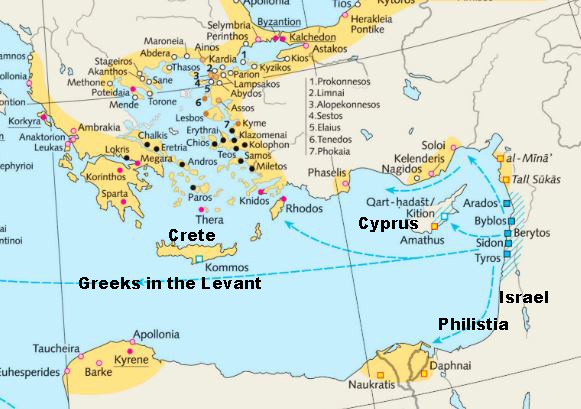
The Greek claim that the Danaans invented the keeled ship, fits nicely with the Biblical claim that the Danites lived in ships, they were after all in possession of the seaport Joppa, where by all indications ship building was a major industry. It is often said, by historians who have studied the matter, that the Phoenicians with their access to the cedars of Lebanon, one of the few trees which produces timbers large enough to be suitable for the task, were the probable inventors of the keeled ship. A simple reclassification of the Hebrew Danite, as a branch of the Phoenicians, makes this speculation fit the Greek myth.
Danans and their next of kin, the sons of Egyptus, settled in Argos alongside existing inhabitants.
Argolis descended from Inarchus, ruled both Mycenae and Argos.
Argolis a regional units of Greece, part of the region of Peloponnese, situated in the eastern part of the Peloponnese peninsula
Rivals of Sparta, ancestors of Alexander the Great.
Apollodorus ( 2.1.4-5), runs thusly; "Belus (the father of Aegyptus) remained in Egypt, reigned over the country, and married Anchinoe, daughter of Nile, by whom he had twin sons, Aegyptus and Danaus, but according to Euripides, he had also Cepheus and Phineus. Danaus was settled by Belus in Libya, and Aegyptus in Arabia."
The Danites had a family quarrel with their brothers the "Jacobites" which caused them to retreat into their ships (the song of Debotrah), the myths have the Danaans fleeing by ship from their brothers, the sons of "Aegyptus."
sons of Perseus immigrated to Argolis from the city of Joppa in Phoenicia, and these more recent Danites had (been).
Commentary: Shows link between Danaan of Greece and of Dan from Israel.
The Identification of Israel with Saturn https://www.britam.org/salverda.html
by John R. Salverda
The populace of Israel was deported by the Assyrians into Assyria and into the cities of the Medes. They carried with them, according to Amos, the star (Chiun, or Kaivan occurs only in Amos 5:26. The LXX. translated the word by Rhephan, which became corrupted into Remphan, as used by Stephen (Acts 7:43 but RSV, "Rephan"). Probably the planet Saturn is intended by the name... of their god.
The Midrash, Josephus, and the Palestinian Targums claim that the so called "Lost Ten Tribes" were carried away by Assyria an placed in a land that, as we learn from the story of Eldad the Danite, was completely surrounded by a river. The river was called the "Sabbation" (this is apparently the same river that Pliny refers to as the "Sambatyon," and is located in the same country that is called by Ptolemy "the land of the Sambatae") named for the holy Sabbath of the Israelites because it flowed for six days then rested. (A myth as it were, it wasn't the flow of the river, but the flow of river traffic that rested every seven days on these rivers so heavily populated by Sabbath worshippers.)
Immanuel Velikovsky, who does not identify the People of Israel with the Umman Manda, (as you [Salverda addresses Yair Davidiy] do, by equating Manda with Manasseh, but as I hope you will see, there is a more compelling meaning for the term) never-the-less does inform us as to the meaning of the word "Manda" The quote from Velikovsky (with footnotes included) runs thusly;
"Thus the Scythians were called Umman-Manda by the Chaldeans (Cyril I. Gadd, The Fall of Nineveh (London, 1926); cf. D. J. Wiseman, The Chronicles of the Chaldean Kings in the British Museum (London, 1956).) '"People of Manda" and Manda is the name of Saturn.' (P. Jensen, Die Kosmologie der Babylonier, p. 114. Cf. The Brihajgatakam of Vahara Mihira, transl. by Swami Vijnanananda (Allahabad, 1912), p. 38, n.2: "Saturn is Manda.") The Phoenicians regarded El-Saturn as their chief deity; Eusebius informs us that El, a name used also in the Bible as a name for God, was the name of Saturn. (Praeparatio Evangelica IV.xvi: "Kronos [El] was deified in the star Saturn." This statement is quoted by Eusebius from Philo's redaction of the lost Phoenician History of Sanchuniathon. Some classical writers, among them Tacitus (Histories V.4) alleged that the Jews were worshippers of Saturn; cf. Augustine's refutation in Contra Faustum Manichaeum XX. 13.) In Persia Saturn was known as Kevan or Kaivan. (Dabistan 31; Bundahis, E. West. P. Jensen, Die Kosmologie der Babylonier, p. 114.)"
It is therefore reasonable to conclude that the phrase "Umman Manda" (People of Saturn) means "People of Israel." Consequently, more to the point of this article, the term "Saturn" is a very probable equivalent to the term "Israel."
-John R. Salverda
Brit-Am Note:
We identified the Umman-Manda as the People [Umman] of Manasseh since the Iranian Peoples often switched a Semitic "s" sound for "d", the Manda equals Mansa or Manasseh. We have shown elsewhere that the term Umman Manda in Mesopotamian terminology first applied to Israelites from the Tribe of Manasseh who dwelt to the West of the Euphrates. Later the term was applied to the Cimmerians and Scythians amongst whom we find members of the Lost Ten Tribes. John R. Salverda points out that Manda actually meant Saturn. This however may not necessarily contradict the name also meaning Manasseh. It may even explain why the Israelites were equated with Manda-Saturn. The first Israelites the Mesopotamians and Iranians came across were probably from the Tribe of Manasseh. Suppose the name Manasseh as they pronounced it sounded the same as the name for Saturn and every nation having to be identified with some star or other. It follows logically that Manasseh (and by extension all other Israelites) would be identified with Saturn! This may hinted at in Amos 5:26.
AMOS (TCB) 5:
26 AND YOU SHALL CARRY SICCUTH YOUR KING AND CHIUN (Saturn?) YOUR IMAGES, KOCHAV YOUR GOD, WHICH YOU HAVE MADE FOR YOURSELVES.
27 AND I WILL EXILE YOU BEYOND DAMASCUS, SAID HE WHOSE NAME IS THE LORD GOD OF HOSTS.
^^^^^^^^^^^^^^^^^^^^^^^^
Europa and Jeroboam of Israel https://www.britam.org/salverda/europa.html
by John R. Salverda
Do Kidnapped Europa and Her Brothers Represent Lost Israelites?
Brit-Am Background:
Greek Mythology relates that the chief god Zeus disguised himself as a white bull and abducted the Phoenician princess Europa daughter of Agenor from her home in Tyre, Lebanon. They went to Crete where Europa gave birth to Minos, Rhadamanthys, and Sarpedon.
Minos became king of the Minoans in Crete.
Sarpadon went to Lycia in Anatolia (in present-day Turkey).
Rhadamanthus went to Boetia in Greece. His sons were Gortys and Erythrus whose name is Greek for Edom.
Virgil (69 - 18 BC) makes Rhadamanthus one of the judges and punishers of the damned in the Underworld (Tartarus) section of The Aeneid.
Pindar says that Rhadamanthus is the right-hand man of Cronus (now ruling Elysium) in the Isles of the Blessed (a term that could be applied to the British Isles) and was the sole judge of the dead. Salverda traces Israelites to Ancient Crete which also had ties to Britain.
The name Europa, is a feminized form of the same Hebrew name that comes to us through Biblical sources, in it's masculine Latin form, 'Jeroboam.' Jeroboam was infamous for reintroducing the worship of god in the form of a bull, and calves were set up as images of god's savior, these constituted the 'sins of Jeroboam.' This tendency toward tauropomorphism, began at the Exodus, when Israel's agent of deliverance, (legends say it was Michael the Archangel) was overwhelmingly agreed, by the very witnesses of the event, to have been a calf, of whom they built a golden image. ... both the Virgin Israel and the maiden Europa, were from Phoenicia.
The Greek myths tell us that Europa had a son who ruled over the Island of Crete, his name was Minos. If Europa be from Jeroboam, and the Cretans spoke Western Semitic, (the same language as the land of Canaan) which they did, then I'll bet 'Minos,' is the same name as 'Manasseh.' In fact one wonders indeed, if there wasn't a bit of confusion between the stories of the Cretan, King Minos, and the later Judean, King Manasseh. How many other kings, from this same area, with the same name, were famous for sacrificing youths to a bull headed god' (Minotaur, Manasseh's Torah' is Manasseh an alternate version of the name Moses' as in Judges, chapter 18, Verse 30, if so, perhaps the Minotaur was blasphemously named for the Law of Moses.) Thus it seems likely that the 'Minoan' civilization was named for the son of Joseph, Manasseh.
The Greeks, in keeping with the identification of Moses with Hermes, (the serpent stick carrying messenger of god who delivers god's earthly wife from her bondage,) credit Hermes as the inventor of the alphabet.
Cadmus is accredited with bringing the alphabet of Hermes, from Phoenicia to Greece, but, not until about 850 BC. It's easy to dismiss all myths in a group as fairy tales, but Cadmus was not a god, he was a man who is famous for doing something which really happened, others who lived within a few hundred years of him speak of Cadmus as an actual historic personage. He came to Greece with a colony and was considered to be the founder of Thebes, a quite well known city in Boeotian Greece, which was even called 'Cadmea,' after him.
Leaving the Sparti in Greece, Cadmus goes to the Northwest, into Europe proper, where they make him King, in the land of the Enchelians (Angels' Angles, or English') where, in the end, he and Harmonia, never really die but are instead Miraculously translated.
^^^^^^^^^^^^^^^^^^^^^^^^
Sisyphus and Joseph by John R. Salverda
https://www.britam.org/salverda/sisyphus.html
the Greek myths tell us, that when Sisyphus founded the city he did not call it Corinth, that name came later, Sisyphus called it, 'Ephyra.' This name is perhaps even more suspiciously Hebrew in origin, for it is the usual Hebrew word for 'fruitful,' and in it's plural form, 'Ephraim,' (doubly fruitful) it is the name of a Hebrew city called after the son of Joseph, and, in fact, the entire House of Joseph (the northern ten tribes) was sometimes referred to as, Ephraim. Another form of the word, 'Ephrath,' (fruitfulness) is the name of the city where Joseph's mother was buried, otherwise known as, 'Bethlehem.'
Recognizing the Corinthians as members of the house of Joseph, fits well into the scriptural perspective concerning the historical migrations of the scattered ten tribes of Israel, because, if this was the case, then the city of Corinth turns out to have been the headquarters of the westward migration of, not merely the Corinthians, but of Ephraim. This migration, according to the history of Corinth, started with a colony at the Island of Corcyra, which spread the culture of Corinth throughout the Adriatic, then they influenced Eturia and Rome from their colony on the island of Ischia off the Bay of Naples, and let us not forget their colony at Syracuse (Syra-gaza, Syrian stronghold') of Sicily, which was founded, as a colony from Corinth in 735, and grew within 350 years to be, perhaps, the most powerful city in the world at that time. These Sicilians, as many others have already pointed out, were no doubt the same ones who have been identified as the 'Sheklesh,' a member nation of the 'Sea Peoples' confederacy who are mentioned in the Egyptian chronicles as being a circumcised people. It is noteworthy that these colonies of Corinth were all founded precisely when you would expect that the population of the city would be swelling with the exiled 'Phoenicians' fleeing from the wrath of the Assyrian raids of Tiglathapiliezer.
Sisyphus was hated to the point of being given a special eternal punishment in Hades, this was for the crime, we are told specifically in the myth, of 'revealing divine secrets.' Joseph, who was derisively referred to as 'the dreamer,' had a similar reason for earning the hatred of his brothers. They did not like the interpretation of his dreams, and it was his ability to decipher the meaning of dreams for which the Pharaoh of Egypt gave him the title 'Zaphnath Paaneah,' which, in Hebrew means, we are told, 'the revealer of divine secrets.'
... the well known modern mythologist, Robert Graves in his famous work, 'The Greek Myths,' quite confidently states, '... Autolycus's use of magic (changing the color of the cows) in his theft from Sisyphus recalls the story of Jacob and Laban.' Graves further cites as his reason for this statement, 'The cultural connexion between Corinth and Canaan, ...' Another probable clue to this identification may lay in the mythic assertion that not only was Sisyphus able to reclaim the cattle that Autolycus had taken but he, as Jacob did Laban's daughter, also took the daughter of Autolycus.
More evidence for the identification of Asopus with Jacob, lies in the mythic claim that Zeus had inflicted Asopus with a permanent limp, as a result of his contention with the king of the gods. Jacob, of course, limped because of a similar contention.
Zeus was compelled to hide from Asopus by disguising himself as a stone, we are further told that this stone was the same one that Sisyphus was eternally forced to establish, however unsuccessfully, upon the infernal mountain. As even the casual student of Greek mythology will recall, this was not the first time that the king of the gods has used a stone to conceal himself from his contender. At the birth of Zeus it was Kronos who was his contender, and Kronos would have swallowed Zeus alive but for the ruse of the young god, who disguised a stone as himself, which was swallowed instead. Thus, Zeus was able to mature in safety, to return at a later date and assume the kingship, in the strength of his manhood, at which time the stone was disgorged, and, as Pausanius (X. 24. 5.) informs us, Zeus subsequently set up the stone at Delphi where it was ritually anointed it with oil, of course, the Greeks are not the only culture, where one finds the odd practice of setting up and anointing a stone (Gen.28:18, 35:14). From the foregoing it would appear that Kronos should be compared to Jacob, but we have already equated Kronos, first with Adam, and then with Ham, therefore it seems that the real comparison, is between Kronos and the 'contender,' any contender, with god. The ancient Phoenicians seemed to have understood this, for as Philo of Byblos, who was quoted by Eusebius, has said, 'Kronos, whom the Phoenicians called Israel...' The 'Stone' is clearly what God has used as a trap in order to deceive his contender, He becomes this stone, 'a stumbling block to both houses of Israel,' as a disguise so He can, 'conceal His face from the house of Jacob,' but, the point is, that the ancient Greeks seem to have known this intricate theological doctrine, almost as well as Isaiah! (Isa.8:13-17).
^^^^^^^^^^^^^^^^^^^^^^^^
Salmoneus as Judah by John R. Salverda
https://www.britam.org/salverda/salmon.html
The enmity between the House of Joseph and the House of Judah is comparable to that between Sisyphus and Salmoneus. Sisyphus keeps trying to establish his stone upon the archetypical mountain, while Salmoneus had appropriated the worship of god to his altars exclusively.
Parallels in Greek Mythology with Biblical tales only indicate the possibility that the Greeks borrowed from the Hebrews. This from the Brit-Am point of ivew is only really important where it helps idenfity the LTTs in their pace of Exuile.
^^^^^^^^^^^^^^^^^^^^^^^^
Background:
# John R. Salverda shows how certain aspects of Greek Mythology owed their inspiration to Hebrew prototypes. This is of value in itself for we may sometimes glean hints of historical realities from these stories. The heroine Io for instance (as shown below) was identified by the Greeks themselves of a later age with the People of Phoenicia and with the Jews. The wanderings of Io may in fact refer to the peregrinations of the Lost Ten Tribes whose identify was transposed by the Greeks to the People of Judah and Phoenicia since these were the closest thing still in the neighborhood to what the Ten Tribes had once been. Also, note that the term "Bosphorus could refer to any one of several different places.#
Moses, Hermes, and Io by John R. Salverda
https://www.britam.org/salverda/io.html
According to the Scriptures, Moses and his followers had a lot of trouble with poisonous serpents, people were sick and dying of snakebite, and so God had bestowed upon Moses a copper serpent that was to be attached to a stick and used for curative purposes, while the mythical Greek character Hermes carried a serpent stick called the 'Caduceus' which was also divinely bestowed upon him and became the worldwide symbol of the medical profession. Some will argue that although the Caduceus did eventually become the symbol of the medical profession, to Hermes himself it was merely the badge of his office as the messenger of god, but of course, it is also true that Moses had another 'serpent stick' which he carried on his missions to bring God's messages to the Pharaoh. We are told by Jewish sources such as the writer Eupolemus, who wrote about 150 BC, that the alphabet was invented by Moses, while according to Greek sources the same alphabet was invented by Hermes. The Egyptian Hermes, whom they called 'Thoth,' is credited with inventing hieroglyphic writing, while the Babylonian Hermes, whom they called 'Nebo,' is credited with inventing cuneiform writing. Nebo, a word that means, the 'Prophet,' was a common nickname for Moses, and when Moses died he was buried upon Mount Pisgah which is also called, no doubt in memory of Moses, Mount Nebo.
I was not the first one to identify Moses with Hermes, in fact this was noticed thousands of years ago, at least as early as the second (some think that he could possibly have lived in the third) century BC by the Egyptian (some think that he may possibly have been Jewish) priest Artapanus. Eusebius (ix. 27) quoted from a lost book that was written by Artapanus and was called 'Concerning the Jews' it said of Moses 'he was beloved by the Egyptians, who called him Hermes.' The Greeks themselves seem to corroborate Artapanus by admitting that the Ibis headed Egyptian god Thoth was just another version of their god Hermes. The Greeks even tell a story of how Hermes had come up out of the land of Egypt, where he once had lived disguised as an Ibis. Like it is in the Hebrew Scriptures, the followers of Moses in the story told by Artapanus, were plagued by poisonous serpents, however the Moses of Artapanus (instead of the copper serpent,) employed the Ibis to attack the snakes. This was the reason, Artapanus says, for which Moses/Hermes revered the Ibis so.
There are quite a few ancient historians who have written chronologies representing Moses as living at the same time as Inachus, the father of Io. ...
The Greek city of Mycenae, after which the Mycenaean civilization itself was named, is considered to be but an offshoot from the city-state of Argolis, these preceded the Ionians of Athens, the Boeotians, the Corinthians, and the Dorians of Sparta, by several generations.
Hermes is so much like Moses. Moses, like Hermes, was the messenger of God, and both were sent by God to free, each their own, chosen ones from their respective captivities. As the 'Psychopompus' Hermes is divinely commissioned as 'leader of the souls' to the promised land, an attribute that is easily derived from the job of Moses. Furthermore Hermes is famed as the god of travelers just as Moses is the leader of those who wandered. According to the Scriptures, Moses and his followers had a lot of trouble with poisonous serpents, people were sick and dying of snakebite, and so God had bestowed upon Moses a copper serpent that was to be attached to a stick and used for curative purposes, while the mythical Greek character Hermes carried a serpent stick called the 'Caduceus' which was also divinely bestowed upon him and became the worldwide symbol of the medical profession.
We are told by Jewish sources such as the writer Eupolemus, who wrote about 150 BC, that the alphabet was invented by Moses, while according to Greek sources the same alphabet was invented by Hermes. The Egyptian Hermes, whom they called 'Thoth,' is credited with inventing hieroglyphic writing, while the Babylonian Hermes, whom they called 'Nebo,' is credited with inventing cuneiform writing. Nebo, a word that means, the 'Prophet,' was a common nickname for Moses, and when Moses died he was buried upon Mount Pisgah which is also called, no doubt in memory of Moses, Mount Nebo.
Eusebius (ix. 27) quoted from a lost book that was written by Artapanus and was called 'Concerning the Jews' it said of Moses 'he was beloved by the Egyptians, who called him Hermes.' The Greeks themselves seem to corroborate Artapanus by admitting that the Ibis headed Egyptian god Thoth was just another version of their god Hermes.
That the nation of Israel itself was symbolically pictured as God's wife is evident from several passages of the Scriptures, notably at Isaiah 54:5 and Hosea 2:1-23 but especially at Jeremiah 31:32, where God's wife is specifically said to have been delivered up out of Egypt; '... I took ... them out of the land of Egypt; ... I was an husband unto them, ...'
The Greeks themselves often referred to the inhabitants of Canaan (also known as Israel) as the descendants of Io, an example of one such early reference is in Bacchylides, who lived at the beginning of the fifth century BC, and wrote an ode about Io, so saying that, "she gave to light, man's greatest line, the roots of Cadmus, Agenor's son, ..." thereby of course, referring to the Phoenicians, or rather, as I hope the reader will come to understand by the fact that they both occupied the same land of Canaan, the Hebrews. (Bacchylides, 19.)
Now, we know that Israel wasn't in Egypt for 430 years, but, on the other hand they were said to have been first in Mesopotamia, then in Canaan, and then in Egypt, before returning to Canaan, for about that length of time. And so, after a closer examination, it does seem possible that the Greek version of Io's wanderings could have originated, like the rest of her story, from the same source as the Hebrew version of a story about the wandering Jews. Incidentally, since this story was brought, it would seem, by the Jews from Canaan to Argolis, we can adduce this migration as the final leg of their wanderings.
As motif number seven we have; 'and a miraculous water crossing.' Having identified the wandering Io, with the wandering Jew, the obvious intent here is to equate the miraculous Scriptural Red Sea crossing, with the also miraculous water crossing of the Bosphorus, by the divine heifer in the Greek myth. Although the name "Bosphorus" is usually reserved as the title for the straits between the Black Sea and the Sea of Marmara, there are other narrow water crossings between land masses, that are also called by that name. Apollodorus tells us in his, 'Library and Epitome' (2.1.3) "Io ... crossed what was then called the Thracian Straits but is now called after her the Bosphorus. (Here, Apollodorus is not referring to the usual Bosphorus, but to the Cimmerian Straits of Phosphorus, a tongue of water that leads from the Black Sea northward into the Sea of Azov now-a-days called the Kerch Strait. It separates the Crimean Peninsula from the Kuban region in the west.)