
by Gunnar Jeremia Gishron
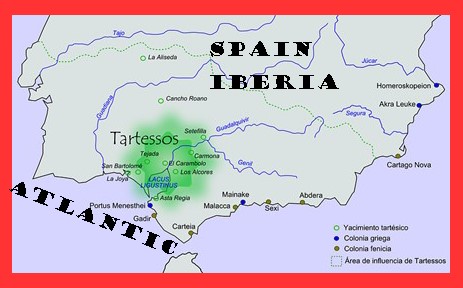

We identify Tarshish with the Atlantic Ocead area in general icluding the British Isles, France, and related areas, and also North America. At one stage there was a region known as Tartessos in Greek, or "Tarsis" in Phoenician in southwest Spain. In Biblical terms "Tarshish" represented the North Atlantic Ocean area. Taking Talmudic sources and commentary to them as a whole the overall picture is that Tarshish meant the North Atlantic area of the Sea whereas the southern section of the Atlantic Ocean was more usually considered the Sea of Africa. Nevertheless, the terms were nterchangeable to some degree. The Isles of Britain could also be referred to as Afriki.
THE DOLLAR BILL, TARSHISH,AND THE TEN LOST TRIBES!
by Gunnar Jeremia Gishron
Sixteen years after the Declaration of Independence there was promulgated a monetary law in America concerning the currency called 'Dollar'. Not many things in American culture actually originated in the United States but most things rather have their origin in Europe. It is well known that the American Dollar actually was an adaptation of the 'Spanish Thaler' called Peso. The symbol '$' originally was the heraldic sign of the Spanish Royal Family which appear on the backside of the Spanish 'Pillar Dollar' and represented the two Pillars of Hercules at Gibraltar with a Latin inscription curled around.
The story of the dollar started in the district of Bohemia in Czechia. There was an enormously rich silver mine in the valley of Joachimsthal, and in the 15th century a new coin appeared on the world market, the 'Joachims-thaler'. It soon became called simply the 'Thaler' in Austria and in Germany and wandering northward and northwestward it changed tits name to 'DALER' in the countries of England, Holland, and Sweden. [From this evolved the term 'dollar'].
In Sweden it was King Gustav-1 Wasa who minted the first Swedish DALER-coin. Nevertheless it was used only in addition to the Mark-coins that continued to be the official currency dating almost half a century. King Gustav-1 Wasa was succeeded by his son John-3 who was married to the Polish Princess Katarina Jagellonica. After John-3 came his son Sigismund who officially became King of Sweden. Sigismund (who mother was the Polish Princess) as well as becoming King of Sweden was already King of Poland. Sigismund had grown up in Poland and was a devout Catholic. In practice however Sweden was ruled by Karl the uncle of Sigismund. Karl acted as regent. Karl was brother of the deceased King John, the third son of King Gustav-1 Wasa, and the uncle of the new King Sigismund. Karl immediately convened Parliament and Sigismund was requested to sign an official proclamation respecting the new Protestant religion of Sweden. Sigismund did sign but it soon became obvious that he had no intention of fulfilling the conditions of the proclamation. Another Parliament was convened in 1599. Sigismund was deposed and Karl was elected (as Karl-9) in his stead.
It was Karl-9 that made the Daler into the new main currency, minting a whole series of 'Nova Moneta' 'new coins' at the turn of the century in 1599 and in 1600. Karl at this stage was still not crowned when he made his monetary reform and introduced the new 'Daler'. He appears without a crown on all coins in this series. Even though Sigismund never had a real chance to regain his crown, Karl-9 refrained from being officially crowned until 1606, four years before his death.
The new currency was quite exceptional. The coins had God's holy four letter name, the so-called Tetragrammaton, engraved upon them, in authentic Hebrew characters with proper vocalization. Around the Holy Name appears something that looks like the rays of the sun and around the periphery of the coins there were additional texts. Often this additional text indicated the slogan of the King in Latin 'solvatum mea'. In Swedish this is 'Gud min trost' or 'In God We Trust'! Karl-9 had a very keen interest in theological questions with an almost 'Calvinist' frame of mind. We have to bear in mind that this was the first Protestant nation in the world fighting for its existence against the Catholics.
King Karl-9 became neither as famous as his father, Gustav Wasa, who finally united Sweden, nor as his son, Gustav-2 Adolf who died the death of a hero in Germany during the 30-Years War, defending the interests of the regional Protestant Lords and Princes. This was ended with the Peace of Westfalen in 1648 and came to lay down the main lines for the religious map of Europe during the following centuries. It is against this background of an intense struggle between Protestants and Catholics that these 'sacred' coins must be understood. The new DALER [i.e. 'dollar'] of the Protestants had an almost American slogan: 'GUD MIN TROST'. This was the personal slogan of King Karl-9 after the custom of Swedish monarchs. 'Trost' and 'trust' are etymologically the same word even if the English 'trust' is [conventionally] translated 'fortrosta' in Swedish. Truly the origins of many English words are to be found in Swedish or in the other Nordic languages. The expression 'GUD MIN TROST' is comparable with the English 'In God We Trust' now printed on every Dollar bill.
Yair Davidiy Comment: Gunnar Jeremia Gishron says that the original Dollar sign was derived from a representation of the Straits of Gibraltar. In ancient times these would stand for Tarshish. Tarshish was a state just to the east of Gibraltar facing the Atlantic Ocean. Tarshish was a trading empire linked with King Solomon and other Israelite monarchs. It had outposts in Gaul and Britain and according to one authority once controlled most of Spain and Gaul. Tarshish in Rabbinical terminology came to represent the whole Atlantic area beyond the Mediteranean and this usage was foreshadowed by the Biblical one. In Isaiah 60:9 it says that the ships of Tarshish are destined to bring the Lost Israelites back to the land of Israel. We have interpreted this in our works to refer to the ships of Britain and North America. The ancient northern Israelites before their exile wrote in Hebrew but also used Egyptian-like hieroglyphic signs. They used to insert these signs in the midst of their Hebrew sentences. The principle of these signs is that as a kind of shorthand one can employ a picture-emblem instead of a word. Were we to employ this method today we could use the dollar sign to represent the USA. This sign already represents American money but it could also be used to represent America in general and we would know what the intention was from the context in which it was employed. By the same method the sign could also represent Tarshish since it is derived from an image of the Straits of Gibraltar.
Gunnar also says that the first dollar had the name of God in Hebrew inscribed upon it and the slogan 'In God We Trust'. It would be interesting to learn if this slogan was later printed on the dollar bill with the knowledge that it had been on the dollar coin or this is another of those historical 'coincidences' we have learned to almost take for granted!
In our Commentary to Isaiah chapter two we also spoke of Tarshish and said:
'Tarshish' can refer to the Atlantic Ocean area and to the USA as explained in 'The Tribes'. Historically Tarshish was centred in Spain with colonies in Gaul and Britain. It was just past the Straits of Gibraltar and so the name (in Biblical exegesis) came to represent the whole Atlantic Ocean area and in a future sense Noth America.
Gunnar Jeremia Gishron of Jerusalem traced the dollar to a coin issued by a Swedish monarch. The original coin included the name of God in Hebrew and the motto in Swedish 'In God WE Trust'!
Later the Spanish adapted the coin and the USA took it from the Spanish. The Spanish version bore the Heraldric sign of the Spanish Royal family. This represented the two pillars of Hercules at Gibraltar. These pillars gave rise to the dollar '$' symbol (with two strokes not one)! The ancient northern Israelites (Lost Ten Tribes) wrote Hebrew interspersed with Egyptian-like hieroglyphics. Where we to use the hieroglyphic system today instead of writing 'AMERICA' or the USA all the time we would substitute '$' as a hieroglyph representing the USA. This one sign ($) could only in the context stand for the USA. This is the sign of Gibraltar, i.e. the sign of Tarshish. Isaiah (60;9) says that ships of Tarshish will be the leaders in returning the exiles.
What Really is Tarshish?
I was requested to comment on the following posting:
Date: Thu, 22 Nov 2001 14:46:22 +0800
Subject: [losttribes] "TARSHISH"
There is no Biblical or scriptural foundation that Tarshish is the USA or Great Britain.
The only "black & white" reference is of Spain and the western mediteranean area, which to mention also had mines working the rich deposits of silver, iron, tin and other metals found there. Jeremiah 10:9 and Ezekiel 27:3, 12 confirm this.
David Wise
[Jeremiah 10:9] SILVER SPREAD INTO PLATES IS BROUGHT FROM TARSHISH, AND GOLD FROM UPHAZ, THE WORK OF THE WORKMAN, AND OF THE HANDS OF THE FOUNDER: BLUE AND PURPLE IS THEIR CLOTHING: THEY ARE ALL THE WORK OF CUNNING MEN.
[Ezekiel 27:3] AND SAY UNTO TYRUS, O THOU THAT ART SITUATE AT THE ENTRY OF THE SEA, WHICH ART A MERCHANT OF THE PEOPLE FOR MANY ISLES, THUS SAITH THE LORD GOD; O TYRUS, THOU HAST SAID, I AM OF PERFECT BEAUTY.
[Ezekiel 27:12] TARSHISH WAS THY MERCHANT BY REASON OF THE MULTITUDE OF ALL KIND OF RICHES; WITH SILVER, IRON, TIN, AND LEAD, THEY TRADED IN THY FAIRS.
Yair Davidiy Replies:
Comment: We had previously sent out a posting on Tarshish consisting mainly of extracts from chapter twelve of our work 'Lost Israelite Identity'. We had apparently not been explicit enough and not included enough sources and should also have quoted from chapter eleven in 'Lost Israelite Identity'.
This is part of what we said in the previous posting:
# The Assyrians claimed to control Tarsis in the far west of their domains. The exact position of Tarsis is still uncertain though a place somewhere on the west coast (more specifically the southwest coast) of Spain, near Gades (Cadiz) is usually accepted. In Classical (Greek and Roman) records there was an important center named "Tartessos" somewhere on the Spanish southwest coast. "Tartessos" is generally identified with the western Tarshish of Scripture. According to one opinion Tartessos once controlled most of Spain and Gaul. Tartessos served as an emporium for goods from Gaul and Britain.
In Scripture and Talmudic sources TARSHISH is often linked with the "Isles of the Sea" (meaning Britain) and with the "Yam Okyanus" (i.e. Oceanic Sea) meaning the Atlantic Ocean.
In some Talmudic accounts Tarshish is taken to refer to the Sea encompassing one third of the world. The Aramaic translation of Yehonathan translates "Tarshish" as "sea". Rashi (the major Talmudic Commentator) says that (the sea) Tarshish is called the Sea of Africa presumably meaning the Atlantic.
In one of the Psalms, it says "The kings of Tarshish and of the isles shall bring presents" (Psalm 72:10): The Aramaic Targum translates this expression to say, "The Kings of Tarsis and of the Isles in the Oceanic Sea shall bring offerings" and by Oceanic Sea (i.e."Yam Okyanus") it is generally understood that the Atlantic Ocean is intended.
"Tarshish" is referred to in connection with the Messianic era and with the return of the exiled tribes of Israel:
"Who are these that fly as a cloud and as a dove to their windows? Surely the isles shall wait for me, and the ships of Tarshish first, to bring thy sons from afar, their silver and gold with them, unto the name of the LORD thy God to the Holy One of Israel because he hath glorified thee" (Isaiah 60:8-9).
The above verse speaks of the exiled of Israel returning to the land of Israel by air (i.e. in aeroplanes) and by ship. The "Ships of Tarshish" means those plying the Atlantic Ocean ('Yam Okeanus') and it therefore follows that Tarshish was someplace on the Atlantic coast. Other sources indicate it meant the north Atlantic Ocean area.
From the above we said that Tarshish referred in our comprehension of the Biblical account and in Talmudic understanding with the north Atlantic Ocean area in general and with Britain and America in particular. We also had a posting from Steven Collins pointing out that the great researcher Cyrus Gordon based on archaeological finds considered 'Tarshish' to refer to North America. The confusion arises since we had said that Tarshish was centered in Spain and from this some want to say that it refers only to Spain and that we are all wrong. The fault is partly ours since it seems that Tarshish was the name of a center west of the Straits of Gibraltar in southwest Spain and ALSO of the whole northern area (in Britain and Gaul) associated with this center. We did not emphasize the last point sufficiently.
In 'Lost Israelite Identity' we wrote:
# The Phoenecians (implied Avienus) had established colonies in Britain. Their monopoly on British tin made them rich and powerful; tin and copper were essential in the production of bronze which was the basic metal employed by most ancient peoples.
Ezekiel said:
TARSHISH WAS THY MERCHANT BY REASON OF THE MULTITUDE OF ALL KIND OF RICHES; WITH SILVER, IRON, TIN, AND LEAD, THEY TRADED IN THY FAIRS [Ezekiel 27:12].
Exekiel is referring to the Phoenicians in Tyre who received silver, iron, tin, and lead from Tarshish. Tin especially was important since it was needed in the production of bronze that was the primary metal used at that time. The tin of Tarshish mentioned by Ezekiel was obtained from Britain.
'Lost Israelite Identity' chapter 11:
The burden of Tyre. Howl ye ships of Tarshish; for it is laid waste. Be still ye inhabitants of the isle; thou whom the merchants of Zidon that pass over the sea have replenished pass ye over to Tarshish; howl ye inhabitants of the isle Pass through thy land like a river, O daughter of Tarshish..daughter of Zidon; arise, pass over to Chittim; there also shalt thou have no rest.." Isaiah ch.23.
The ships of Tyre are "ships of Tarshish" and it is predicted that Tyre would be destroyed and an attempted re-establishment would be made in Chittim which would be unsuccessful and from there a move to Tarshish itself (in Spain) would have to be made.
Sargon (722-705) claimed to have conquered Anaku and Kaptara in the Atlantic Ocean. "Anaku" is said to mean the Land of Tin and could refer to Britain whilst Kaptara (i.e. "Cyprus" in Assyrian terms) in the Atlantic Ocean apparently means Scandinavia where Bronze Age remains show direct contact with Mediterranean areas such as Cyprus, Egypt, and the Middle East . Egyptian descriptions of a Kaptara (i.e. "Cyprus") in the Atlantic Ocean are apposite to what is known concerning the civilisation of Scandinavia at that time. Sennacherib (705-681) took Tyre and began the organised exile and re-settlement of its inhabitants.
Esarhaddon (681-669) boasted of controlling Yadnana (i.e. 'Isle of the Dananu', meaning Cyprus), Yaman (Yavan meaning Greece), and Tarsis (meaning Tarsis of the Atlantic) presumably in Spain. Assyrian references explicitly mention Tarsis as the westernmost extremity of Phoenician colonisation. According to Avienus and various sources the Phoenicians had colonies in Britain and this fact together with other indications suggests that the concept of "Tarshish" as well as intending someplace on the southwest or west coast of Spain also encompassed the British Isles and one understanding of the name "Tarshish" itself is "sea" or "ocean"* and therefore places or isles in the ocean. The inscription just quoted of Esarhaddon mentioning Yadnana, Yaman, and Tarsis, has been found duplicated in a prism but instead of "Tarsis" the name "Nu-si-si" is given. The exact meaning of this name is unclear though it would seem to be cognate with "nes" meaning Island in Aramaic as well as in Greek. The said inscription of Essarhaddon could thus be understood as saying:
" The kings that are in the midst of the sea, from the Isle of the Dananu [Yadnana = Cyprus], from Greece [Yaman = Yavan], and from the Islands ["Nusisi"] [or from: "Tarsis"] bowed to my feet ...over the four corners of the earth my power was spread.."
From the above we see that Tarshish in addition to being a place in southwest Spain (west of Gibraltar) was also interchangeable with 'islands' and was considered the westernmost region known to the Assyrians and the Assyrians did know of Britain and minerals from Britain were considered as coming from Tarshish. The Talmud considered Tarshish to be the Atlantic Ocean area in general associated with the Isles of the Sea meaning Britain.
In addition in a note to 'Lost Israelite Identity' chapter twelve we had noted:
12.* Some modern scholars explain the word "Tarshish" to mean "forgers" or "furnace" and to refer to metal-working. The Talmudic explanation linking "Tarshish" to the sea is actually more feasible. Tarshish is the name of a son of Javan (Genesis 10;3) meaning Ionia and Greece and Elyakim ben Menachem points out that "Thalasos" in Greek came to mean "Sea" and the "l" (of "Thalasos") is interchangeable with "r". This observation makes the names "Tharsis" (i.e. Tarshish) and "Thalasos" ("Sea") different forms of the same word. Cyrus Gordon (1978, JNES, 37) said that the Greek word 'Thalassa' which was their commonest term for 'sea' was of Near Eastern origin with roots attested in Egyptian, Hebrew, and hieroglyphic Hittite. The word is cognate with Tarshish.
In other words according to the above the Talmudic equation of Tarshish with the Sea is paralleled on linguistic grounds with a usage in Greek, Egyptian, Hebrew, and Hittite.
The other point we mentioned is perhaps equally important:
Tarshish was seen to represent the sea area beyond the Pillars of Hercules, i.e. the Atlantic Ocean. In Prophecy this refers to North America, Britain, and related areas. The symbol of the USA can be taken as being the dollar sign. This sign is derived from a Spanish coat of arms representing the Straits of Gibraltar (Pillars of Hercules) beyond which lay the realm of Tarshish that included America or was to do so in the future.
The Prophets spoke in terms of their own reality. Isaiah 60:9 saw the Isles and the ships of Tarshish associated with the return of the exiles of Israel. In Isaiah's time ships of Tarshish probably included those trading with Tartessos in Spain as well as those traveling from Britain. This does not mean that in the future ships of Tarshish have to come from those places or from both those places. Isaiah was referring to whatever would evolve in the future from what was represented by 'The ships of Tarshish' in his time.
Etymologies & Word Origins:
http://www.google.com/search?q=cache:WuYU7Q5XDIo:www.wordorigins.org/wordord.htm+dollar+origin&hl=en
The origin of the almighty dollar is in what is now the Czech Republic. In 1519, a silver mine near the town of Joachimstal (literally "Joachim's valley," from the German Tal, meaning valley) began minting a silver coin called, unimaginatively, the Joachimstaler coin, which was circulated widely, became better known by its clipped form, the "thaler." In Dutch and Low German, the initial consonant softened to become "daler". English adopted this form, eventually changing its spelling to the modern dollar.
In the American colonies, there was no standard currency. The coin that was in widest use was the Spanish Peso, known also as "Pieces of Eight" because it could be divided into eight pie-like pieces. The English colonists informally assigned the name dollar to this coin. In 1785, when the Continental Congress established U.S. currency, they adopted dollar as the name for the standard unit of currency, at the suggestion of Governeur Morris and Thomas Jefferson, because the term was widely known and was not associated with any form of official English currency. (Jefferson also coined the term disme, from the French dixieme, for a tenth of a dollar. Pronounced deem, it eventually became dime.) The origin of the $ sign has several folkloric stories attached. One says that Thomas Jefferson invented it, perhaps as a sort of monogram for TS. Jefferson was the first to use the symbol in relation to the U.S. dollar, but this story is fanciful. Another says that originally it was U superimposed over an S, for U.S. of course. Eventually the base of the U eroded due to poor printing technology, leaving an S with two lines through it. Another says that it is a variant of a figure eight that appeared on the Spanish Peso, standing for the pieces of eight. This last is close to the truth, but not quite there.
The Spanish royal family used on its escutcheon, two pillars (representing the Pillars of Hercules in Gibraltar and Morocco) crossed by an unfurled banner reading "Plus Ultra." This symbol appeared on the Peso, and looked much like the modern $ sign. It was adopted as a symbol for the Peso in the American colonies, and was transferred to the dollar. The U.S. was the first nation to adopt an official currency named the dollar. In 1797, the Bank of England began minting "dollar" coins as bank-issued currency. Other nations that have adopted the name dollar for their currency have done so in emulation of either the U.S. or this short-lived Bank of England practice.