
History and Geography
Contents:
1. Geography.
2. Foundation.
3. Early History.
4, Modern Times.
5. Jews in Venice.Jews in Venice. Shylock,.
6. Odds and Ends.
7. The City of Padua.
^^^^^^^^^^^^^^^^^
^^^^^^^^^^^^^^^^^^

1. Geography
Venice is a city in northeastern Italy and the capital of the region of Veneto. It is built on a group of 126 islands that are separated by expanses of open water and by canals; portions of the city are linked by 472 bridges.
Refugees from other parts of Italy arrived fleeing barbarian invasions. They found refuge on the sandy islands in the lagoon, learned to build by driving closely spaced piles consisting of the trunks of alder trees, a wood noted for its water resistance, into the mud and sand, until they reached a much harder layer of compressed clay. Building foundations rested on plates of Istrian limestone placed on top of the piles.
As of 2025, the city proper (Commune of Venice) has 249,466 inhabitants, nearly 50,000 of whom live in the historical island city of Venice.
Together with the cities of Padua and Treviso, Venice is included in the Padua-Treviso-Venice Metropolitan Area (PATREVE), which is considered a statistical metropolitan area, with a total population of 2.6 million.
^^^^^^^^^^^^^^^^^^
2. Foundation.
The name is derived from the ancient Veneti people who inhabited the region by the 900s BCE. The city was the capital of the Republic of Venice from 810 CE to 1797. It was a major financial and maritime power during the Middle Ages and Renaissance, and a staging area for the Crusades and the Battle of Lepanto, as well as an important centre of commerce, especially silk, grain, and spice, and of art from the 1200 to ca. 1700 CE. The sovereignty of Venice came to an end in 1797, at the hands of Napoleon. In 1866, the city became part of the Kingdom of Italy.
Italian refugees from nearby areas fleeing successive waves of Germanic and Hun invasions (300s to 500s CE) first came to Venice. Earlier settlement had however existed in the area . The twelve founding families of Venice elected the first doge (i.e. Duke), and the candidates in most cases traced their lineage back to Ancient Roman families.
It is likely that an important source of the early prosperity of Venice was the trade in slaves, captured from the north in central Europe and sold to North Africa and the Levant.
^^^^^^^^^^^^^^^^^^
3. Early History.
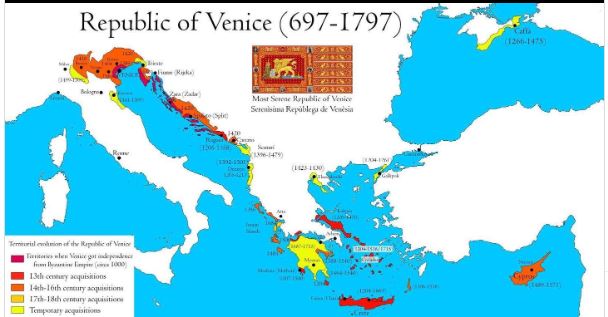
The early history of Venice was dominated by Ravenna which is nearby to the south. It had been founded by the Umbri people. Ravenna consisted of houses built on piles on a series of small islands in a marshy lagoon, a situation similar to Venice several centuries later. Ravenna, instead of Rome, was the capital of the Western Roman Empire (402 - 476 CE) . Venice on the other hand was associated at first more with the Eastern Byzantine Empire which also had possessions in the area. From the 800s to the 11000s CE Venice developed as a thalassocracy or maritime Empire. The government of Venice was through a Senate and selected leaders in a system similar to that of the Ancient Romans. Venice was noted for its sound monetary policies, especially its reliable gold ducat, which underpinned growing confidence in Venetian trade and finance Venice established bases on the eastern shores of the Adriatic hence it traded with Byzantinum (modern Istanbul) and the east. Venice also had colonies along the shores of the Black Sea and in the Crimea. In building its maritime commercial empire, Venice dominated the trade in salt, acquired control of most of the islands in the Aegean, including Crete, and Cyprus in the Mediterranean, and became a major power-broker in the Near East. In the Fourth Crusade of 1204 Byzantium (Constaninople) was sacked by the Crusaders. After the fall of Constantinople, the former Eastern Roman Empire was partitioned among the Latin crusaders and Venice. Venice subsequently carved out a sphere of influence in the Mediterranean known as the Duchy of the Archipelago, and captured Crete. The attack on Byzantium had been instigated by the Venetians. Much valuable booty was brought back to Venice from Constantiple including valuable manuscripts. In the late 1200s at the peak of its power and wealth, Venice had 36,000 sailors operating 3,300 ships, dominating Mediterranean commerce. Venice's leading families vied with each other to build the grandest palaces and to support the work of the greatest and most talented artists. Venice was Roman Catholic in religion but frequently quarreled with the Papacy over its relative religious tolerance.
After the invention of the prining press by 1482, Venice had become the printing capital of the world.
Venice sent ships to assist Constantinople against the Turks which however fell in 1453.

Vasco da Gama (c. 1460s - 1524) from Portugal discovered the first direct maritime route between Europe and India via the Cape of Good Hope and across the Indian Ocean from Malindi in Kenya to Kozhikode (India). This opened up European exploration of, and commerce with, India, and the East. After Da Gama's first voyage (1497-1499) Portugal became Europe's principal intermediary in the trade with the East by sailing around the Cape of Good Hope. There was less need for Venice.
The Battle of Lepanto was a naval engagement that took place on 7 October 1571 when a fleet of the Holy League, a coalition of Catholic states arranged by Pope Pius V and led by the navies of the Spanish Empire and the Republic of Venice, inflicted a major defeat on the fleet of the Ottoman Empire.
The Black Death followed by other plagues eliminated a good portion of the Venetian population. The Italian plague of 1629 - 31 killed a third of Venice's 150,000 citizens.
Meanwhile the relative importance of Venice had already declined.
Nevertheless, even after these changes Venice was nearly always relatively prosperous.
Venice remained a major exporter of agricultural products and, until the mid-1700s century, a significant manufacturing centre.
^^^^^^^^^^^^^^^^^^
4, Modern Times
Napoleon Bonoparte conquered Venice in 1797 and removed the gates of the Jewish Ghetto allowing Jews to live where they wished. After the defeat of Napoloen Venice was taken over by the Austrian-held Kingdom of Lombardy-Venetia. In 1866, after the Third Italian War of Independence, Venice became part of the newly created Kingdom of Italy.
During Wor;ld War-2 Venice had been a hotbed of anti-Mussolini Italian partisan activity. On 29 April 1945, a force of British and New Zealand troops of the British Eighth Army, under Lieutenant General Freyberg, liberated Venice.
Historically Venice played an impressive role for quite a while.
Venice Today.
Wikipedia sums it up for us:
# In the 21st century, Venice remains a very popular tourist destination and a major cultural centre, and has often been ranked one of the most beautiful cities in the world. It has been described by The Times as one of Europe's most romantic cities and by The New York Times as "undoubtedly the most beautiful city built by man". However, the city faces challenges, including overtourism, pollution, tide peaks, and cruise ships sailing too close to buildings.
^^^^^^^^^^^^^^^^^^
5.. Jews in Venice. Shylock,.
The first complete and uncensored printed edition of the Talmud was printed in Venice by Daniel Bomberg in 1523. A complete edition (which still exists) was sent to Henry-8 of England.
During World War-2 Jews were rounded up in Venice and deported to extermination camps. Since the end of the war, the Jewish population of Venice has declined from 1,500 to about 500. Only around 30 Jews live in the former ghetto, which houses the city's major Jewish institutions.
Venice is famous for being the scene of the play "The Merchant of Venice" by William Shakespeare.
See:
Shylock, the Merchant of Venice
#3. Shylock, the Merchant of Venice. Deconstructing what makes the Bard's play so problematic
https://hebrewnations.com/25/bhr/bhr132.html#a3
#2. Was Shakespeare a Believing Jew?
https://aish.com/was-shakespeare-a-believing-jew/
by Yehezkel Laing
Extract::
One of the world's most celebrated authors, James Joyce, even hints at Shakespeare's Judaism in his famous book Ulysses. When John Wyse Nolan reaches for his Shakespeare book he says, "I'll say there is much kindness in the Jew."
cf.
If you had been Shylock in Shakespeare's 'The Merchant of Venice', what would you have done?
https://www.quora.com/If-you-had-been-Shylock-in-Shakespeares-The-Merchant-of-Venice-what-would-you-have-done/answer/Yair-Davidiy
Shylock is the name of a Jewish Moneylender in Venice. He is a fictional character delineated by William Shakespeare' in his play "The Merchant of Venice" (c. 1600).
The name Shylock is actually an English Gentile family name many of whom traded in gold, etc, or worked as letter-writers, etc. For some reason they were identified as Jews!
The plot of 'The Merchant of Venice' by William Shakespeare concerns a Christian merchant in Venice of the 1500s who must default on a large loan provided by a Jewish moneylender. The Jew is named 'Shylock'. The Christian hero and his friends regularly insult Shylock. The contract says that if the Christian defaults he must pay with a pound of flesh. The Jew demands payment as written. In the end Shylock is denied the right to take the life of the Christian. He is humiliated. His daughter is married off to a Christian. The young couple take what remains of his fortune. Shylock is impoverished and forced, on pain of death, to convert to Christianity. The treatment of Shylock by his Christian adversaries is presented as self-obvious and proper though some ambivalence remains.
Previously there had been a TRUE report from Italy (reported by the historian, Cecil Roth) in which a Christian demanded a pound of flesh as payment of a debt from a Jew. This case of Christian vindictiveness may have been transformed into a tale illustrating alleged Jewish rapacity. The transformation from victim to culprit would have already taken place in literary sources before reaching Shakespeare. He may well have believed the tale he wrote about. Shakespeare may have been dealing with what he mistakenly understood to have been an historical event.
Heinrich Heine (1839) relates:
# When I saw this piece played in Drury Lane there stood behind me in the box a British beauty who, at the end of the fourth Act, wept passionately, and many times cried out, 'The poor man is wronged!' It was a countenance of noblest Grecian cut, and the eyes were large and black. I have never been able to forget them, those great black eyes which wept for Shylock!
When I think of those tears... Shakespeare perhaps intended originally to please the mob... But the genius of the poet... was ever stronger than in his own will, and so it came to pass that Shylock, despite the glaring grotesqueness, expressed the justification of an unfortunate sect which was oppressed by providence....
Shylock was often depicted with red hair.
^^^^^^^^^^^^^^^^^^
6. Odds and Ends.
Venetti in Gaul
https://hebrewnations.com/articles/quora/tentribes/venettii.html
Brit-Am Now no. 3215
#4. Addition to Article. Genoa and Venice in Italy Founded by Philistines!
https://hebrewnations.com/25/no20/3215.html
Added to:
What is the connection between Palestinians and Illyrians?
https://www.quora.com/What-is-the-connection-between-Palestinians-and-Illyrians/answer/Yair-Davidiy
Don Isaac Abarbanel (1437-1508) claimed to have found in ancient books information that the Philistines of old had founded the cities of both Genoa and Venice. The area of Venice adjoins and to some degree overlaps with that of Ancient Illyria.
German Intentions to Annex Venetia
In our work,
"Esau. Edomites Today"
http://www.britam.org/Esau.html
we discuss the case of Venice. In the Middle Ages and after them Venice was a very powerful and influential entity.
Venice appears to have been founded by Edomites descendants of Esau. As such it shares features with part of the population of Germany, Russia, Japan, and other places.
In light of the above we found the following sentence of interest:
Allan Bullock, " Hitler: A Study in Tyranny", 1952, Revised Edition, NY, 1962,
p.713:# In October [1943] Mussolini had to surrender Trieste, Istria, and the South Tyrol to Germany, and there was even talk of incorporating Venetia in Greater Germany. #
Venice and the Philistines and Others.
What is the connection between Palestinians and Illyrians?
https://www.quora.com/What-is-the-connection-between-Palestinians-and-Illyrians/answer/Yair-Davidiy
The Philistines are mentioned in the Bible. They were related to the Egyptians but had also dwelt in Crete and Anatolia (present-day Turkey) see Genesis 10:4, Amos 9:7. Their culture was basically Canaanite though they had acquired some cultural features from Mycenean and Minoan civilizations. Linguistic evidence also suggests a connection with the ancient area of Illyria on the east Adriatic coast (Croatia, Bosnia, Montenegro, Albania). The original Philistines eventually disappeared. They had also dwelt to the southwest of Ancient Israel i.e. in Philistia which included Gaza. The Arab incursions have taken the place of the Philistines in public consciousness as well as their name. Even the Bible uses the name "Philistine" to refer to the Palestinians in our time. There is a prophecy (Isaiah 11:13-14) that Ephraim and Judah in the End Times will join forces to evacuate them by wing and fly the Palestinian - Philistines to some place in the west.
SEE:
https://www.quora.com/Why-doesnt-Israel-relocate-its-Jewish-citizenry-from-the-West-Bank-and-Gaza-close-its-borders-and-call-it-the-end-of-the-story/answer/Yair-Davidiy
https://www.quora.com/What-is-the-difference-between-Philistine-and-Palestine/answer/Yair-Davidiy
At all events there does not seem to be any connection between the Palestinians and Ancient Illyria though one never knows.
ps. It is worth noting that the Biblical Commentators and International statesman Don Isaac Abarbanel (1437-1508) claimed to have found in ancient books the information that the Philistines of old had founded the cities of both Genoa and Venice. The area of Venice adjoins and to some degree overlaps with that of Illyria.
# Don Isaac Abarbanel, the esteemed Jewish statesman, philosopher, and biblical commentator — lived in Venice for the final five years of his life, arriving in 1503. He was actively recruited by the Venetian Republic to negotiate commercial treaties with Portugal. During this time, he completed his major commentaries on the Torah and the Prophets. #
https://hebrewnations.com/articles/sources/rabbisquoted.html
ABARBANEL, Abravanel. Isaac ben Judah Abarbanel (1437-1508), commonly referred to as Abarbanel, also spelled Abravanel, Avravanel or Abrabanel, a Portuguese Jewish statesman, philosopher, Bible commentator, and financier. Wrote an extensive verbose commentary on the entire Bible, along with philosophic works. Don Isaac Abarbanel says that his forebears were descended from King David. King Afonso-5 of Portugal employed him as Treasurer. When Alfonso died Abarbanel fled to Castile (Spain) in 1483. He was employed by Queen Isabella as financier but he left Spain in 1492 when the Jews were expelled. Abarbanel went to Naples, Italy, and died in Venice in 1508. Abarbanel writes often about the Ten Tribes. He says that the Lost Ten Tribes are now in Exile but will return and re-unite with Judah. This, he declares, is one of the Principles of Belief in the Bible. He also emphasizes the presence of descendants of Israel being among the English.
MORE ABOUT ABARBANEL IN VENICE.
Isaac ben Judah Abarbanel (1437-1508) was born nin Portugal. At the age of 20 King Afonso V of Portugal, employed him as treasurer. in 1483 he fled to Castile in Spain. He worked on the finances of Isabella-1 until the Jews were expelled from Spain and he moved to Naples on Italy. He movedcvwith the King of Naples to Messina in Sicily then to Corfu in Greece, and from there to Venice.
.
Extract:
Preference for republics: Impressed by the governance of Venetian and Italian city-states of his era, Abarbanel used 1 Samuel 8 to argue that short-term, elected representative governments are halachically and practically superior to any monarchy.
AI
Trade Negotiations: He used his high-level financial expertise to successfully help negotiate a commercial agreement regarding the spice trade between Venice and Portugal.
Scholarly Work: Devoted his remaining time to writing extensive and renowned Jewish biblical commentaries.
Death and Legacy
Passing: He died in Venice in 1508 at the age of 71, receiving an honorable funeral attended by local civic and religious leaders.
Burial: Transported and buried in nearby Padua next to Rabbi Judah Minz, though the grave was later lost during the 1509 Siege of Padua.
Abarbanel wrote copious commentaries on most books of the Bible as well as other works on Jewish Philosophy. Apart from his verbosity his style is modern in manner and still relevant today.
Don Isaac Abravanel wrote that his family claimed descent from King David.
#20. Other Philistine Possibilities. Poland, Italy.
Orjan Svenssun ("Philistines in Poland?") tells us:
# A Polish author claims that the alternate/old name of Poland, Lechia, see Lechia, may have something to do with Ramat-Lechi of the Philistines mentioned in Judges 15:9. #
Philistines in Poland? [4595]
https://hebrewnations.com/articles/gis/poland.html
Craig White quotes Lempriere that at the mouth of the Po River in Italy there was a place name "Fossae Philistinae?"
^^^^^^^^^^^^^^^^^
Padua is an important city about 25 miles from Venice.
According to Tradition Padua was founded by Antenor who led a group of Trojans and their Paphlagonian (in Western Anatolia) allies, the Eneti or Veneti, to settle the Euganean plain in Italy. This was the beginning of Venice, Padua, and other areas.
Padua came under the rule of the Republic of Venice in 1405, and mostly remained that way until the fall of the republic in 1797.
The scientists Nicolaus Copernicus (1473--1543) and Galileo Galilei (1564-1642) taught or studied. in the University of Padua,
In the same unbiversity in Padua lived and learned the RAMCHAL (Moshe Chaim Luzzatto 1707-1746), and Rabbi Moshe David Valley (1697-1776). The two knew each other and learned from one another.
Luzzato authored "The Way of the Just" (Mesillat Yesharim 1740. This is an ethical treatise that presents a step-by-step process by which every person can overcome the inclination to sin and might eventually experience divine inspiration similar to prophecy. This work was very important in the History of Orthodox Judaism. It is still required reading (in short excerpts) for thousands of Yeshiva students in Israel.
Luzatto also wrote other books of importance.
Valley wrote, or was associated with, an extensive commentary on the Entire Bible containing insights of value.
See: RABBIS QUOTED.
https://hebrewnations.com/articles/sources/rabbisquoted.html