
Insights to a Hebrew Presence


Was the Island of Britain named Tarshish?
Previous articles on this subject:
Tarshish and the LTTs
https://hebrewnations.com/articles/peoples/tar.html
Extract:
Britain
Some 19th-century commentators believed that Tarshish was Britain, including Alfred John Dunkin who said "Tarshish demonstrated to be Britain" (1844), George Smith (1850), James Wallis and David King's The British Millennial Harbinger (1861), John Algernon Clarke (1862), and Jonathan Perkins Weethee of Ohio. This idea stems from the fact that Tarshish is recorded to have been a trader in tin, silver, gold, and lead, all of which were mined in Cornwall. This is still reputed to be the "Merchants of Tarshish" today by some Christian sects.
The researcher Cyrus Gordon identified Tarshish with the American Continent.
Tarshish
Spain and North America
https://hebrewnations.com/articles/peoples/tarshish.html
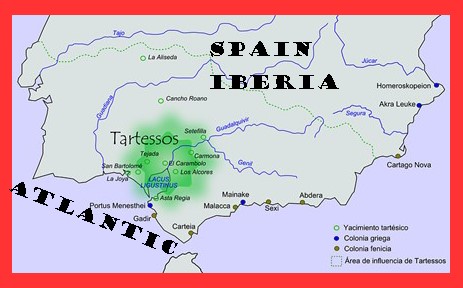
We found the "Port of Menesseh" in Tarshish in southwest Spain and other evidence indicating an Israelite presence.
Rashi (1040-1105): Proceed. You inhabitants of Tyre, to flee to Tarshish.
Rashi identifies the "Island dwellers" as inhabitants of Tyre (which was originally an island off the coast) who were being induced to move to Tarshish.
Extracts from Article.
Tarshish.
Spain and North America
https://hebrewnations.com/articles/peoples/tarshish.html
Extracts:
# We identify Tarshish with the Atlantic Ocean area in general including the British Isles, France, and related areas, and also North America. At one stage there was a region known as Tartessos in Greek, or "Tarsis" in Phoenician in southwest Spain. In Biblical terms "Tarshish" came to represent the Atlantic Ocean area. Taking Talmudic sources and commentary to them as a whole the overall picture is that Tarshish meant the North Atlantic area whereas the southern section of the Atlantic Ocean was more usually considered the Sea of Africa. Nevertheless, the terms were inter-changeable to some degree. #
Isaiah (TCB) 60:
9 FOR THE ISLES WILL GATHER FOR ME, AND THE SHIPS OF TARSHISH [as] IN THE BEGINNING, TO BRING YOUR SONS FROM AFAR, ....
In Scripture and Talmudic sources TARSHISH is often linked with the "Isles of the Sea" (meaning Britain) and with the "Yam Okyanus" (i.e. Oceanic Sea) meaning the Atlantic Ocean. In some Talmudic accounts Tarshish is taken to refer to the Sea encompassing one third of the world. The Aramaic translation of Yehonathan translates "Tarshish" as "Sea." Rashi (the major Talmudic Commentator) says in one place that (the sea) Tarshish is called the Sea of Africa presumably meaning the Atlantic. Taking all the commentary together the overall picture is that Tarshish meant the North Atlantic area of the Sea whereas the southern section of the Atlantic Ocean was considered the Sea of Africa. Nevertheless, the two terms to a degree are interchangeable. Britain was in the Tarshish (North Atlantic) area but it still could be referred to as "Afriki".
The prophet Ezekiel listed Tarshish amongst the numerous places that were wont to trade with Tyre of the Phoenicians:
"TARSHISH WAS THY MERCHANT BY REASON OF THE MULTITUDE OF ALL KINDS OF RICHES; WITH SILVER, IRON, TIN, AND LEAD, THEY TRADED IN THY FAIRS" (Ezekiel 27:12).
In some old British Israelite writings "Tarshish" is identified with Britain.
Isaiah 23:6 is translated as:
Isaiah 23:6 PROCEED TO TARSHISH, WAIL, YE ISLAND DWELLERS!
Rashi explains the passage to say:
"Proceed. you inhabitants of Tyre, to flee to Tarshish."
Rashi understanfs the passage like most of the Commentators: He speaks of Tyre and Tarshish. We previously understood it to be speaking about the Island of Tyre which was primarily an island off the coast of Lebanon that traded with Tarshish in Spain.
There was another place of importance, also called Tarshish, in southeast Turkey near the border with Syria. Nevertheless the major commentators and researchers all agree that here by Tarshish is indeed the place known as 'Tarsis' to the Phoenicians and as Tartessos to t he Greeks in the southwest of Spain,
The Hebrew original (Isaiah 23:6) may be understood to say:
"Proceed to Tarshish wail ye island dwellers!"
Ths brings up the question, Who are are the inhabitants of Tarshish? "Are they the "island dwellers" ?
i.e. that the "Island dwellers" are the inhabitants of Tarshish?
This morning, in my local Synagogue, a Rabbinical Scholar remarked that he had understood "Tarshish" to be an island.
TO BE CONTINUED.
This morning, in my local Synagogue, a Rabbinical Scholar remarked that he had understood "Tarshish" to be an island.
TO BE CONTINUED.

>